
Bollard-proof LTD
The Challenge
Bollard failures are becoming an increasing safety concern for ports and shipping operators worldwide. Mooring bollards play a vital role in securing vessels during loading and unloading, yet when one fails under load the consequences can be severe. A detached bollard can launch back toward the vessel or become airborne over long distances, posing a serious threat to people, infrastructure and vessel hulls. At the same time, the loss of a single mooring point puts immediate strain on remaining bollards, increasing the risk of multiple failures and potential vessel drift or allision.
Ports rely on bollards every day, and as with any mechanical system, wear and degradation over time are inevitable. The key challenge has been finding a reliable, accurate method to test bollards in situ—one capable of replicating real mooring forces without damaging the structure or requiring costly replacements.
The Innovation
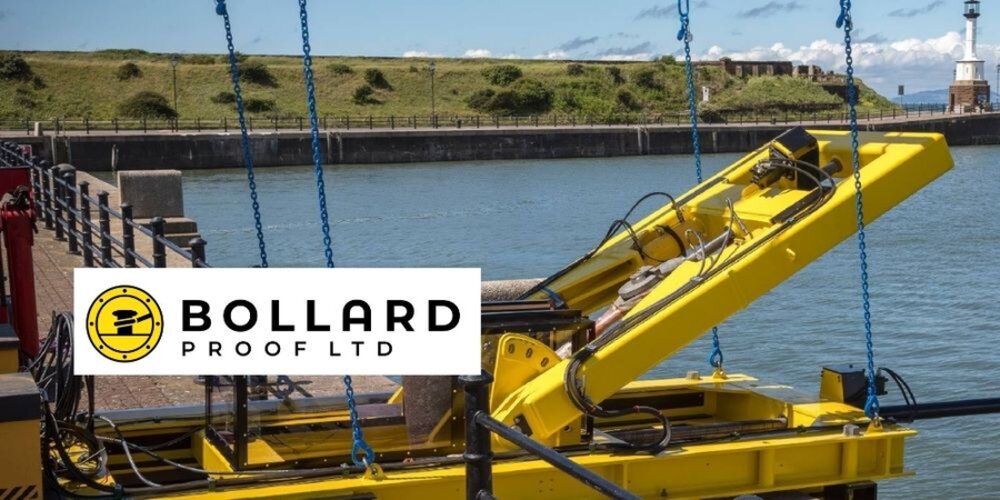
Bollard Proof Ltd has developed the first non-destructive, mobile test rig capable of applying both vertical and horizontal loads to a bollard, mimicking real world mooring forces. The device can pull at combined angles up to 75° vertically and 30° horizontally, applying a working load limit of up to 165 tonnes. Load is precisely monitored through an inline load pin, while a laser scanning system detects any substrate deflection during testing.
A short, low elasticity synthetic rope minimises stored energy, ensuring safe operation even if a compromised bollard fails under load. The rig reacts against the existing dock structure, enabling accurate simulation of mooring line forces on both new and legacy bollards. It is suitable for preinstallation verification, commissioning of new bollards and the assessment of older units whose condition or provenance may be unknown. This represents a significant improvement over traditional tug pulls or bollard to bollard tests, which cannot replicate realistic loading angles or confirm true working load limits.
How It Was Implemented
The innovation was initially adopted by forward thinking UK ports such as ABP, Forth Ports and Port of Tyne, who recognised both the regulatory need and safety benefits. Bollard Proof conducted multiple tests across these sites, building asset histories and giving port engineers vital data about bollard capability and condition. Early client feedback helped refine the rig, leading to additional models—including a compact version for remote dolphin structures and adaptable methods for bollards positioned away from quay edges.
What Was the Result
With more than 2,000 bollards tested across the UK, Europe and overseas locations such as Guadeloupe and Corsica, Bollard Proof has demonstrated the value of accurate, non-destructive testing. Their work has expanded into multiyear contracts and international projects, supported by a digital platform that geolocates every tested bollard and stores inspection records, photos and certificates. This provides ports with a comprehensive and easily accessible asset register and early warning system for scheduled retesting.
Conclusion
Demand for Insite proof load testing is rapidly increasing as ports seek safer, more cost effective ways to verify the integrity of mooring infrastructure. Non-destructive testing allows ports to confirm working load limits, extend the life of existing bollards and avoid unnecessary replacements. As standards evolve—including upcoming PIANC guidelines—routine testing will become integral to safe maritime operations. Bollard Proof’s technology offers a practical, accurate and globally scalable solution, helping ports improve safety, protect infrastructure and support secure vessel berthing worldwide.
- Date
- 25/08/2026