
SICK-AG MultiScan100-S
The Challenge
Automation in container terminals requires a constant balance between safety, productivity and system availability. Nowhere is this more evident than in collision avoidance for Container Handling Equipment (CHE), such as Rail‑Mounted Gantry Cranes (RMGs).
Automated cranes typically operate in constrained areas protected by physical barriers or sensor‑based safety systems. While conventional safety sensors can detect obstacles, they are often limited by environmental influences such as rain, fog, dust and changing light conditions. These factors frequently trigger false alarms, forcing cranes to slow down or stop unnecessarily. Limited detection ranges further restrict operating speeds, directly reducing throughput and availability.
As a result, terminals face a persistent dilemma: conservative safety settings protect people and assets but undermine productivity, while higher speeds increase risk. True safe automation requires detection technologies that are reliable in real‑world outdoor conditions, minimise false positives and integrate seamlessly into existing control architectures.
The Innovation
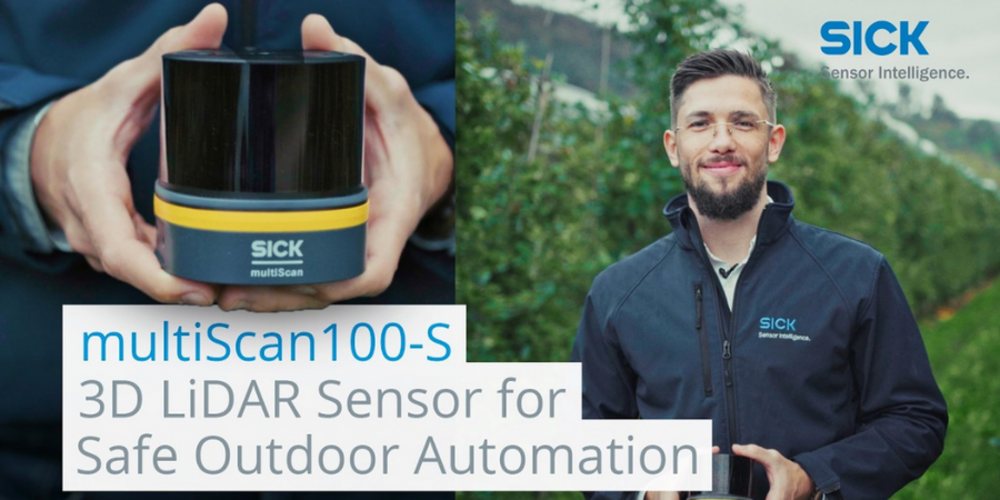
multiScan100‑S addresses this challenge as the first safety‑certified 3D LiDAR sensor specifically designed for industrial outdoor applications, including automated container terminals.
At the heart of the innovation is Safe Multi‑Echo Technology, which allows the sensor to distinguish real objects from environmental interference. Rain, fog and dust are filtered out, enabling the sensor to “see through” disturbances and detect actual obstacles behind them—while maintaining its full safety‑rated detection range. This dramatically reduces false positives and enables higher operating speeds without compromising safety.
multiScan100‑S introduces a new certification benchmark. It is compliant with ISO 13849 (Performance Level b) and IEC TS 62998 (Performance Class C) for outdoor use and is already Performance Level c ready, with detection reliability for higher safety levels proven and certified. When combined with standard safety controllers and established diagnostic concepts such as cyclic field set switching, enhanced safety architectures can be implemented with minimal effort.
With a safety‑rated detection range of up to 20 metres, multiScan100‑S enables fast, fluid crane movements while delivering exceptional availability and flexibility for application‑specific designs. It closes a long‑standing gap by delivering safe collision avoidance without sacrificing productivity.
How It Was Implemented
multiScan100‑S combines two certified safety functions within a single sensor architecture: Safe Measurement Data and Safe 3D Object Detection.
Safe Measurement Data provides access to safety‑rated raw and pre‑processed measurement data via a standard UDP Ethernet interface. This enables system integrators to develop customised, high‑performance safety concepts beyond traditional sensor outputs, including safety‑related localisation, mapping and advanced perception algorithms. Data integrity is ensured through the established black‑channel principle.
Safe 3D Object Detection provides on‑device decision‑making using configurable protective fields. Object detection results are transmitted directly to the safety PLC via switching signals, ensuring compatibility with virtually all safety controllers commonly used in RMGs and other CHE.
Both safety functions can operate simultaneously, offering maximum flexibility. This dual‑function approach bridges next‑generation sensing technology with proven industrial safety concepts, enabling advanced collision‑avoidance systems without disrupting existing architectures.
Result
multiScan100‑S has been validated through extensive testing and real‑world deployment. Within the last 12 months, Künz GmbH successfully completed a test installation on a rail‑mounted gantry crane, while iSAM AG conducted an intensive nine‑month test programme.
The sensor’s safety certification explicitly defines and validates operational limits for all relevant environmental conditions. This allows multiScan100‑S to operate at its full safety‑rated range under certified conditions, without requiring additional validation by system integrators or end users.
Operational results demonstrate a significant reduction in false positives, improved availability and higher achievable process speeds. True 3D detection enables reliable identification of complex scenarios such as overhanging loads or full‑body person detection—capabilities beyond the reach of conventional 2D systems.
Conclusion
multiScan100‑S represents a step‑change in safe automation for container terminals. By combining safety‑certified 3D LiDAR technology with robust environmental filtering and flexible integration concepts, it resolves the long‑standing trade‑off between safety and productivity.
The sensor delivers reliable collision avoidance in real‑world outdoor conditions, enabling faster crane movements, higher availability and consistent safety performance. It provides terminals and crane manufacturers with a future‑ready foundation for next‑generation automated container handling.
- Date
- 25/08/2026