
Turtle Fire Systems, LLC
The Challenge
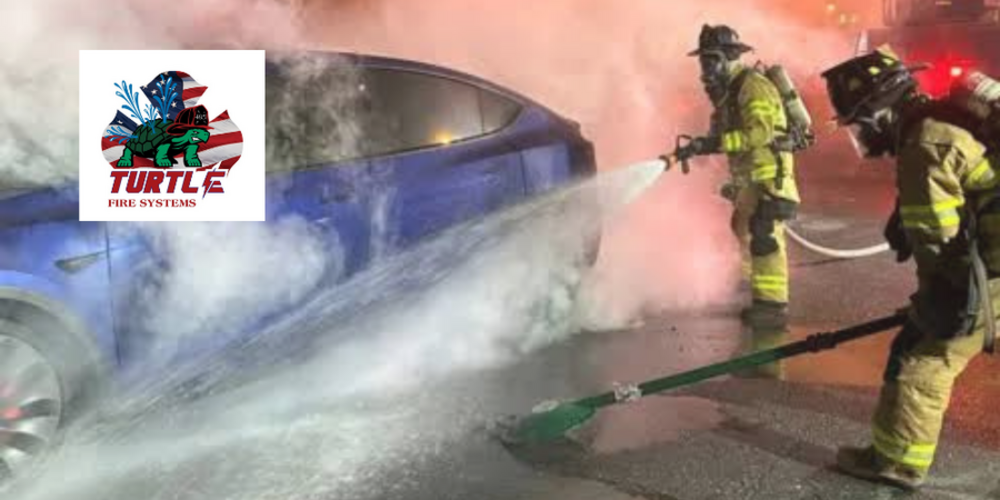
Electric vehicle (EV) fires present a rapidly growing safety challenge across global logistics. On land, lithium-ion battery fires expose first responders to extreme heat, toxic gases and prolonged thermal runaway events. At sea, these hazards are compounded by confined spaces, limited ventilation, restricted water supplies and crews who are not specialist firefighters.
Ferries and roll-on/roll-off (RORO) vessels increasingly transport EVs, yet onboard firefighting systems were never designed for this type of risk. A single battery failure can escalate quickly, spreading horizontally from vehicle to vehicle and threatening deck integrity, cargo, passenger safety and vessel survivability. Traditional suppression methods rely heavily on indirect deck sprinklers or manual hose lines, both of which provide limited cooling to the battery itself and expose crews to hazardous environments.
The challenge is clear: crews need a simple, reliable and effective way to apply continuous, targeted cooling directly to the source of an EV fire—without requiring advanced firefighting training or placing personnel in danger—buying critical time until full suppression or external assistance is available.
The Innovation
The Mini Turtle Fire System, and its maritime-specific adaptation, the Maritime Mini, was developed to meet this exact need. Designed to deliver sustained, low-profile, targeted cooling, the system applies water directly beneath an electric vehicle, battery assembly or deck surface—where heat concentration is highest.
For maritime use, the Maritime Mini is constructed from stainless steel with brass couplings for corrosion resistance and compatibility with marine environments. It can be fixed-mounted or connected directly to a vessel’s existing 1.5-inch handline coupling, enabling rapid deployment by ship crews. Its flow rate of 150 gallons per minute (GPM) is carefully balanced to provide effective cooling while minimising listing risk and preserving vessel stability. For land-based operations, the standard Mini Turtle operates at up to 310 GPM, offering versatility across environments.
The system’s patented dome shape and 360-degree flow pattern ensure even water distribution around battery casings and adjacent surfaces, reducing hotspot formation and slowing horizontal fire spread. Once positioned, the unit provides stable, continuous spray without constant adjustment, significantly reducing crew exposure during prolonged incidents.
Durable, manoeuvrable and intuitive to use, the Maritime Mini can be deployed beneath vehicles on ferry decks, installed as a dedicated EV “sprinkler zone,” or positioned near high-risk activities such as welding operations to provide immediate fire control capability.
How It Was Implemented
The Turtle Fire System was originally developed by firefighters to address emerging fire risks with practical, field-tested solutions. It has since been adopted by municipal, military, airport and industrial fire departments and incorporated into emergency response plans at multiple automotive manufacturing facilities worldwide.
Building on this success, the Maritime Mini is now being adapted for vessel operations through collaboration with ship safety professionals, marine fire brigades and Coast Guard representatives. These subject-matter experts have identified several effective deployment models, including fixed installations within EV cargo lanes, portable handline use by ship crews or fire watch teams, and stationary placement near hot-work zones.
This phased, collaborative approach ensures the system translates proven land-based firefighting principles into a form suitable for maritime crews and environments.
Result
The Turtle Fire System has already demonstrated strong performance in controlled EV burn tests and real-world deployments on land, achieving rapid heat reduction, improved firefighter safety and reduced re-entry times.
Early maritime demonstrations indicate the Maritime Mini delivers comparable benefits at sea. Crews with limited firefighting experience can apply cooling water directly to the ignition source without entering hazardous spaces. Deck surface temperatures are reduced, and horizontal flame spread between vehicles is slowed—critical factors in preventing escalation and preserving hull integrity.
These outcomes align directly with the priorities of maritime logistics: protecting life, maintaining vessel stability and reducing cargo loss. Ongoing engagement with vessel operators and marine safety teams continues to confirm the system’s practicality and value in diverse operational scenarios.
Conclusion
The Turtle Fire System was created to make firefighting safer, simpler and accessible. Its evolution into the Maritime Mini reflects a commitment to adapting proven technology to emerging hazards in global transport.
By enabling ship crews to act early and apply targeted cooling with confidence, the Maritime Mini provides a vital layer of protection for personnel, passengers, cargo and vessels during EV fire incidents. Beyond the technology itself, the system embodies the principles of collaboration, learning and continuous improvement that underpin effective safety innovation.
We believe innovation has value only when it protects people, preserves assets and strengthens resilience. The Maritime Mini is a practical step forward in meeting the evolving fire risks of electric vehicle transport at sea.
- Date
- 25/08/2026