
Sibre - Snag Load Protection And Guardian
The Challenge
Ship‑to‑Shore (STS) cranes operate under extreme loads, tight schedules and high safety exposure. One of the most serious and costly risks in container terminals is the snag‑load event—when a container becomes unintentionally caught during hoisting or lowering.
Snag loads develop within milliseconds and generate extreme dynamic forces that can lead to wire‑rope failure, structural damage, sudden crane stoppages and severe danger to personnel on vessels, quays and cranes. Even a single event can result in prolonged downtime, significant repair costs and heightened safety risk.
Conventional detection systems, based on load cells or hydraulic pressure, are inherently reactive. They register abnormal forces only after damaging tension has already entered the hoisting system. In many cases, harm has already occurred by the time the system responds.
The industry has long needed a solution capable of acting before destructive forces develop.
The Innovation
SIBRE’s Snag Load Protection (SLP), together with its Guardian add‑on, delivers the world’s first preventive protection system for snag‑load events, redefining safety for STS crane operations.
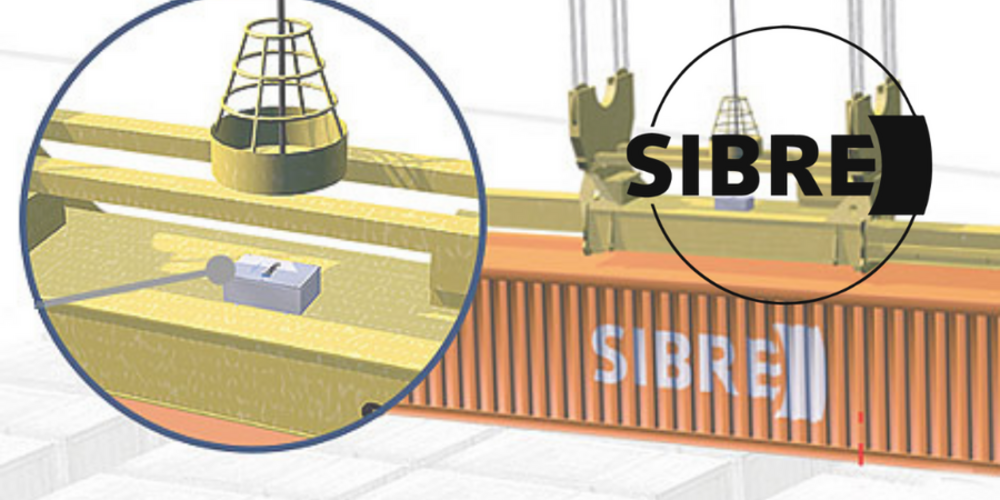
SLP uses a high‑precision Inertial Measurement Unit (IMU) mounted directly on the headblock, where snag‑load dynamics originate. The IMU continuously captures real‑time acceleration and angular‑velocity data. Machine‑learning algorithms—trained on thousands of operating hours and real snag‑load scenarios—analyse this motion data to detect hazardous patterns before dangerous tension builds up.
When an imminent snag‑load condition is identified, SLP triggers ultra‑fast automatic brake activation within milliseconds, stopping the hoisting motion before damage occurs. This represents a fundamental shift from reactive protection to true anticipation and prevention.
The Guardian add‑on extends SLP into a comprehensive IIoT safety and performance platform. It introduces a new KPI—Motion Intensity—which quantifies the smoothness or abruptness of crane movements. This enables predictive maintenance, operator performance optimisation and reduced mechanical stress. Guardian also detects 360‑degree impacts and synchronises video footage, giving operators and engineers immediate insight into events and root causes.
Together, SLP and Guardian form a single intelligent safety layer that enhances crane resilience, supports automation, reduces downtime and extends the service life of critical components.
How It Was Implemented
The system has been successfully deployed on more than 50 STS cranes at leading container terminals worldwide, including APM Terminals, TIL, DP World, PSA, SSA Marine and Evergreen.
SLP integrates seamlessly with cranes from all major OEMs—ZPMC, Konecranes, Liebherr, Kocks, Paceco and Mitsubishi—and interfaces with PLC platforms from Siemens, ABB, TMEIC and Toshiba. It supports both fibre‑optic and copper reeling cable systems and is compatible with all hoisting configurations, including single‑hoist, dual‑hoist tandem and single‑hoist tandem cranes.
The solution is scalable, OEM‑agnostic and suitable for both retrofits and new crane installations.
Result
Development included a two‑year data‑capture phase to build and validate robust detection algorithms. Following proof‑of‑concept deployment, intensive end‑user testing confirmed near‑zero false positives and false negatives.
Operational results demonstrate that SLP prevents approximately 90% of snag‑load incidents and significantly mitigates the remaining cases. This has reduced crane and vessel damage, lowered unplanned downtime and improved safety outcomes.
By limiting peak stress on hoisting components, operators have recorded wire‑rope service‑life extensions exceeding 30%. Reported return on investment is typically less than two years, with some terminals recouping costs through the avoidance of a single major snag‑load incident. Several operators now specify SLP as standard for new crane deliveries.
Conclusion
SLP and Guardian represent a step‑change in port crane safety, shifting the industry from reactive damage control to true prevention. By detecting hazardous motion before destructive forces develop, the system protects people, equipment and operations at the most critical moment.
Proven at scale, across multiple operators and crane OEMs, SLP delivers measurable safety improvements, increased equipment longevity and strong financial returns. It sets a new global benchmark for intelligent, preventive safety systems and defines the future of safe, resilient and high‑performance STS crane operations.
- Date
- 25/08/2026