
Euroports Group BV / Notra Oy
The Challenge
At several Euroports locations, paper pulp is handled during loading and unloading from seagoing vessels, barges, trucks and trains. The pulp arrives in bales of approximately 200 kg, bundled into units of eight bales secured by heavy steel lifting wires. These units are lifted in and out of vessels and then transported by truck to nearby paper mills.
At the factory, the heavy lifting wires must be removed and the bales rotated to the correct orientation before entering the production line. As the mills do not have the necessary equipment, this process must be carried out at the port. Previously, wire removal and re‑wiring were performed manually.
This manual process exposed workers to several risks. Cutting high‑tension steel wires created the danger of wire ends snapping back, causing cuts to the arms, legs or face, with potential eye injuries despite mandatory protective equipment. The operation also required forklift assistance near personnel, adding significant person‑machine interface risks. In addition, re‑wiring was physically demanding, introducing manual handling and fatigue‑related safety concerns.
The Innovation
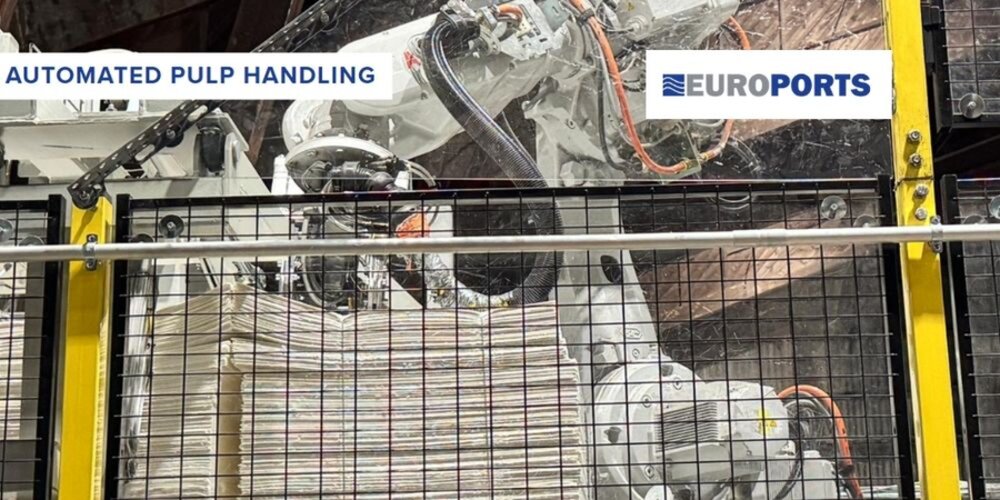
To eliminate these risks, Euroports introduced an automated pulp handling system based on a robotic arm operating within a fully fenced and protected area. The system completely separates personnel from machinery and is equipped with automatic shutdown sensors that stop operation instantly in the event of any breach.
The robot removes the heavy lifting wires from the pulp units and compacts them into bundles for metal recycling. It then inspects the integrity of the strapping wires on individual bales and rotates the units horizontally to prepare them for automated re‑wiring. The entire process is monitored by an operator located outside the safety enclosure, ensuring oversight without exposure to risk.
How It Was Implemented
The system was designed and built on site through close collaboration between the equipment supplier and Euroports’ local technical and operational teams. Customer input was incorporated to ensure the solution met mill requirements, including bale dimensions, weights and wire specifications.
Following installation, a structured testing phase identified challenges caused by real‑world variations in bale configuration. These issues were resolved through iterative adjustments, ensuring reliable operation under normal working conditions.
What Was the Result
With intact pulp units, the system processes up to 60 units per hour using only one operator and one machine driver. Previously, the manual process required three workers performing high‑risk, physically demanding tasks.
By removing wires and preparing bales at the port, turnaround times are reduced and the process becomes simpler for customers at the mill. Most importantly, automation has dramatically reduced injury risk, improving occupational health and safety for stevedores.
Conclusion
This innovation enables Euroports to modify and prepare pulp units from multiple mills safely, efficiently and cost‑effectively. It removes high‑risk manual tasks, improves productivity and strengthens Euroports’ commitment to safe, modern cargo handling operations.
- Date
- 25/08/2026