
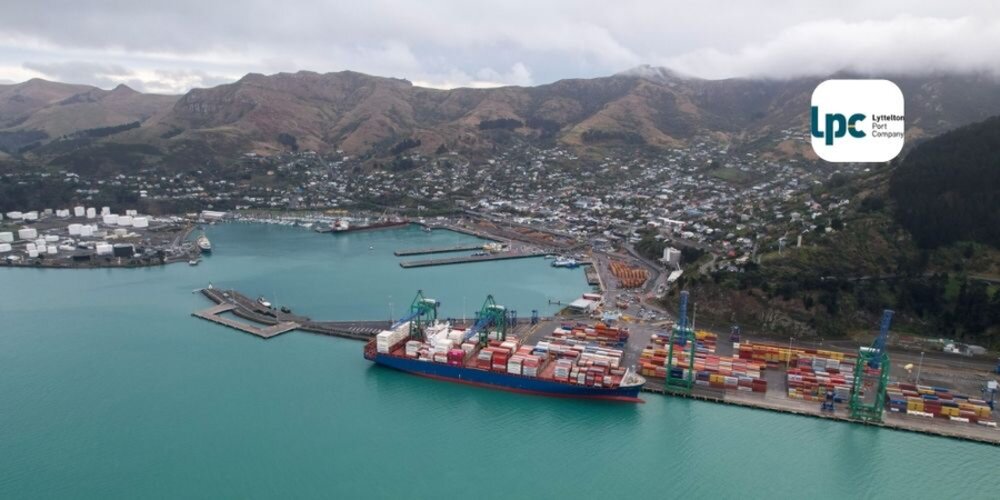
Lyttelton Port Company (LPC), Christchurch, New Zealand
The Challenge
Across Lyttelton Port Company’s Inland Ports and Empty Container Depots, a wide range of activities historically required personnel to work at height. These included container roof inspections during inbound container survey processes, container stack inspections following high‑wind events, and structural roof inspections to meet building compliance requirements.
Traditionally, these tasks required staff to access elevated work platforms (EWPs) or ladders, often involving substantial manual handling, complex safety controls and significant time delays. LPC handles approximately 500,000 TEU per year, requiring surveyors to repeatedly ascend and descend EWPs to inspect every incoming empty container roof for damage.
High‑wind events (>32 knots) presented additional risks. Container stacks—up to seven containers high—had to be manually inspected before operations could safely resume. This involved personnel entering active yards, creating exposure to person‑versus‑plant risk and the danger of further container movement during gusts. Structural roof inspections similarly exposed staff to working‑at‑height hazards and required scaffolding or edge protection.
While risk controls were in place, LPC recognised that eliminating work at height was the preferred and safest outcome, rather than relying solely on procedural controls.
The Innovation
LPC introduced drone technology equipped with advanced, high‑resolution camera systems to conduct visual inspections remotely. This innovation allows personnel to remain safely on the ground, removing them entirely from hazardous operational zones.
The drone’s manoeuvrability and powerful zoom capability enable inspectors to identify container roof damage with high clarity, assess repair requirements, and confirm IICL compliance without physical access. High‑quality images can be shared directly with customers, improving transparency and speeding up decision‑making.
The technology also enables safe inspection of seven‑high container stacks following high‑wind events—areas that are otherwise difficult or unsafe to assess visually. By removing people from hazardous environments, this approach has delivered a substantial improvement in safety while increasing inspection efficiency.
How It Was Implemented
As one of the first port and empty container depot operators in New Zealand to adopt drones for this purpose, LPC implemented the technology cautiously and with safety as the primary focus. The initiative was led by the Site Operations Supervisor, who worked closely with operational teams to assess training needs, equipment suitability, durability, battery performance and customer‑engagement opportunities.
Survey staff completed comprehensive drone‑operator training, and all required approvals were secured from the Civil Aviation Authority. Detailed Safe Work Method Statements and risk assessments were developed to identify and control hazards prior to deployment, ensuring full regulatory and operational compliance.
What Was the Result
The impact has been significant. By removing the need for personnel to physically access container roofs, LPC has eliminated a critical working‑at‑height risk. Staff have fully embraced the solution, recognising both the safety benefits and productivity gains.
Inspection efficiency has increased dramatically. What previously took up to five minutes per container can now be completed for five to ten containers within the same timeframe—a tenfold productivity improvement. Additional applications, such as perimeter‑fence inspections, have reduced tasks that once took up to two hours to just 15–20 minutes.
Conclusion
Drone technology has delivered a step‑change in how LPC manages safety and efficiency. By eliminating working at height, the port has removed one of the most significant risks faced by its workforce, while improving inspection speed, accuracy and consistency.
This initiative demonstrates that meaningful safety improvements need not be complex or costly. A drone investment of approximately NZ$900 has produced substantial gains in safety and operational performance. Interest from other New Zealand operators confirms the broader industry value of this approach.
Through this innovation, LPC has set a benchmark for proactive safety leadership—showing that eliminating risk at its source delivers the most effective and sustainable outcomes.
- Date
- 25/08/2026