
Lase Industrielle LaserTechnik GmbH- LaseAsto
The Challenge
Container terminals and industrial yards present complex operational environments where trucks, cranes and pedestrians work in proximity. A persistent safety challenge in these settings is the presence of blind zones around trucks and heavy equipment. Crane operators often have restricted visibility, particularly below the crane boom and around vehicle sides, increasing the risk of collisions with people, other vehicles or infrastructure.
Conventional safety measures such as mirrors and camera systems offer only limited protection. Their effectiveness is often reduced by glare, poor lighting, dust, rain or adverse weather conditions. At the same time, regulatory expectations are increasing, with terminals required to deploy certified safety systems capable of reliably monitoring danger zones and initiating automatic interventions. However, few solutions on the market meet the demanding requirements of EN ISO 13849 Category 3 PLd, leaving a critical gap in certified, high‑integrity area surveillance.
The Innovation
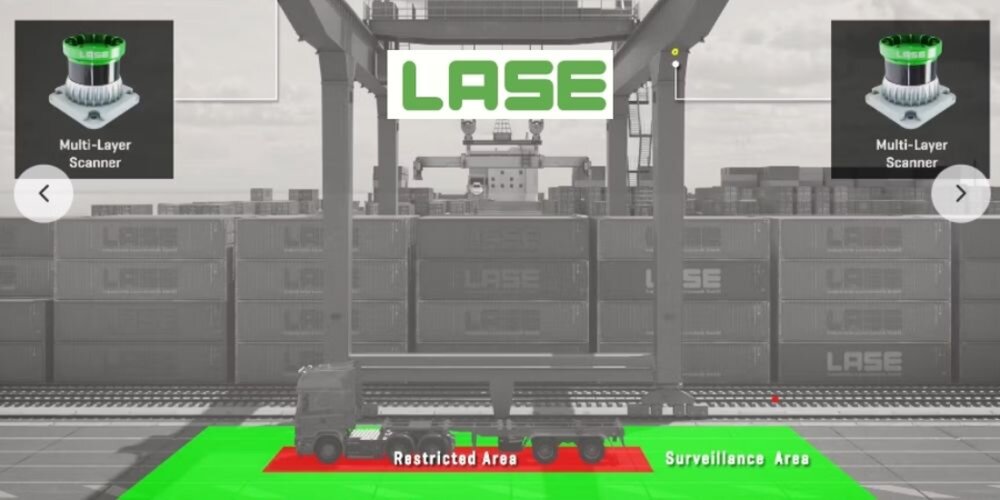
LaseASTO is an advanced area surveillance system designed specifically to protect truck operations beneath container cranes. The system uses high‑precision 3D multi‑layer laser scanning technology to continuously monitor predefined safety zones around vehicles in real time.
When a person, object or obstacle enters a configured hazardous area, LaseASTO generates a certified safety signal compliant with EN ISO 13849 Cat.3 PLd. This enables automatic intervention, such as initiating a controlled crane stop, reducing reliance on human reaction times and mitigating the risk of serious incidents. The laser‑based technology performs reliably in challenging conditions, including darkness, dust, rain and high‑traffic environments.
LaseASTO can be seamlessly integrated into both new and existing crane installations. Its robust, maintenance‑friendly design ensures dependable operation while delivering consistent people detection and hazard monitoring. By combining precise sensing with certified safety functionality, LaseASTO sets a new benchmark for preventive risk mitigation in container handling and mobile industrial operations.
How It Was Implemented
The development and deployment of LaseASTO followed a structured process combining operational field experience, advanced sensor technology and certified safety engineering. A redundant system architecture was designed to meet EN ISO 13849 Cat.3 PLd requirements, with validated safety logic and defined protective fields adapted to terminal layouts.
Extensive field testing was conducted under real operating conditions, including tight manoeuvring, varying weather and dense equipment movement. Following successful validation and certification, the system was introduced with comprehensive documentation and operator and maintenance training, supporting smooth integration into existing workflows.
What Was the Result
Terminals deploying LaseASTO have reported significant reductions in near‑miss incidents, particularly in blind‑spot and pedestrian interaction zones. Automated stop functions ensure rapid, consistent responses regardless of operator fatigue or distraction, while improved situational awareness increases operator confidence.
The durable laser‑based solution requires minimal maintenance and supports higher safety compliance levels. Its certified status provides operators with audit‑ready safety assurance while supporting ongoing progress toward more automated and standardized terminal operations.
Conclusion
LaseASTO demonstrates the impact that certified 3D sensing technology can have on improving safety in demanding container handling environments. By combining precise laser detection with EN ISO 13849 Cat.3 PLd certification, the system delivers a reliable, automated safeguard for truck operations beneath container cranes. Its proven performance highlights strong potential for broader adoption across ports, logistics hubs and industrial sites where blind zones and human‑machine interaction remain critical risks.
- Date
- 25/08/2026