
TT Talk - When routine becomes risk: vehicle deck safety in port operations
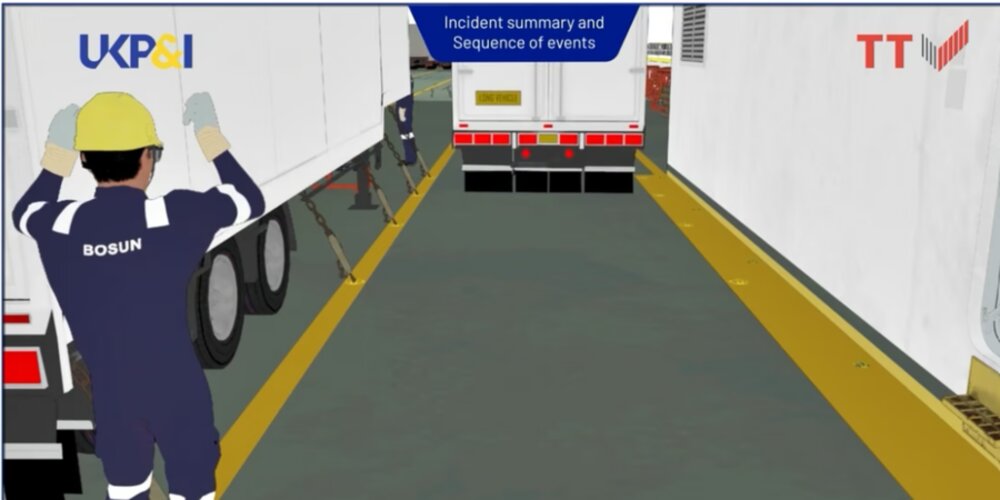
Vehicle deck operations are among the most familiar activities in the Ro-Ro and ferry environment. Trailers are marshalled, reversed, parked, trestled, lashed and released countless times each day across ports and terminals around the world. Precisely because these tasks are so familiar, risk tolerance can increase through over-familiarisation, where repeated exposure to a hazard without a negative outcome reduces the perception the associated risk.
The recent UK P&I Club “Lessons Learnt” animation, developed as part of the collaborative work between TT Club and UK P&I Club, provides a powerful reminder that routine operations can rapidly become high-consequence events when visibility, communication, supervision and segregation fail.
The animation reconstructs a fatal crush incident on the upper vehicle deck of a Ro-Ro ship. A ship was alongside in port, with shore tractor-unit drivers manoeuvring heavy trailers into marked stowage spaces under the direction of ship’s crew. Four trailers had already been parked and secured; only one tight corner space remained, bordered by the ship’s structure. As the final trailer reversed, the banksman moved from a visible position into a narrow gap between the trailer and a stiffening beam. The trailer continued to move, creating a fatal pinch point with no escape route.
Although the incident occurred on board a ship, the lessons are not confined to ship operators. Vehicle decks are shared operational spaces sitting at the interface between ship, port, terminal and stevedoring activity. Responsibility for safe performance is therefore typically distributed across several parties, each of whom may control part of the risk picture but rarely the whole. For TT Club Members, the incident should be viewed through the lens of operational interface risk: where people, vehicles, time pressure, ship design and local working practices converge. Incidents of this nature illustrate how risks can emerge at operational interfaces, where responsibilities overlap and assumptions may develop between different organisations involved in the same task.
Incidents of this nature illustrate how risks can emerge at operational interfaces, where responsibilities overlap and assumptions may develop between different organisations involved in the same task.
For port authorities, the first question is whether vehicle deck interfaces are being treated as a live operational risk within the port’s wider safety management framework. Port authorities may not direct each trailer movement, but they often shape the environment in which those movements occur: berth planning, traffic flow, contractor access, permit systems, port rules, emergency response arrangements and standards expected of operators working within the port estate. Where Ro-Ro activity forms part of the port’s regular business, vehicle deck operations should not be assumed to be solely a ship matter. They should be considered as part of the port’s overall approach to managing high-risk interfaces between ship and shore.
Terminal operators are closer still to the activity. Their influence extends to planning the operation, allocating resources, coordinating with the ship, managing shore drivers, controlling traffic flows and ensuring that work is not compressed into unsafe practice by turnaround pressure. The animation highlights several recurring weaknesses: loss of situational awareness, a false sense of safety created by painted walkways that are not physically segregated, insufficient supervision, failure to stop when visual contact is lost, unmarked hazards and procedural gaps for tight-space manoeuvring. For terminal operators, these are not abstract “human factors”; they are practical management issues that should be addressed through planning, supervision, layout, communication protocols and intervention culture.
Stevedore operators and labour providers face the most immediate exposure. Their personnel often work in close proximity to moving plant, ship structures, lashings and cargo units. The key safety principle is simple: no person should be positioned where an unsighted vehicle can move into them. Yet the conditions that lead to harm are frequently more complex. A banksman may reposition to get a better view. A driver may assume the path remains clear. A painted walkway may create a false perception of protection where no physical separation exists. A familiar task may be performed without the level of challenge applied to a novel or exceptional operation. The animation captures this clearly: the tragedy unfolded in only a few seconds from an operation that appeared entirely routine.
This is why the collaboration between TT Club and UK P&I Club is important. Both Clubs see the consequences when operational interfaces are not effectively controlled. The vehicle deck animation is a practical, experience-led learning tool, designed to visualise the risk, highlight normal operations, signpost operational challenges and reinforce core safety principles. The collaboration reflects a broader shared objective: converting incident experience into accessible guidance that supports better decision-making before harm occurs.
The message for operators is not that procedures are unimportant. Rather, it is that procedures must reflect how work is actually carried out. A safe system of work should answer practical questions: who controls each vehicle movement; where should the banksman stand; what happens if visual contact is lost; how are blind spots and pinch points identified; who has oversight of the whole deck; how are shore drivers briefed; and does everyone understand that any doubt requires the job to stop?
Several controls deserve particular attention
- Segregation should be physical wherever practicable; painted lines do not stop moving vehicles.
- Line-of-sight rules must be absolute: if a driver loses sight of the banksman, the movement stops.
- Only one banksman should control a movement, using standardised signals understood by all parties.
- High-risk stowage positions—particularly tight corners, restricted gaps and areas adjacent to ship structure—should be identified before work starts.
- Supervision must be independent enough to monitor the overall operation, not absorbed entirely into the task being performed.
More broadly, vehicle deck safety requires a culture in which stopping the job is normal, supported and expected. The animation’s lessons align closely with that principle: be seen, stay seen; take time, do not take chances; and stop the operation if anything looks unsafe. These messages are simple, but they require consistent reinforcement through induction, toolbox talks, contractor management, near-miss review and visible leadership.
vehicle deck safety requires a culture in which stopping the job is normal, supported and expected. The animation’s lessons align closely with that principle: be seen, stay seen; take time, do not take chances; and stop the operation if anything looks unsafe.
The human factors at play here that diminish risk perception need continuous focus, an embedded and robust safety culture utilising regular unannounced audits safety teams to help break habitual complacency.
TT Club’s mission is to support a safer, more secure and more sustainable transport and logistics industry. In the port and terminal environment, that means helping Members identify the points where routine activity can conceal serious exposure. Vehicle deck operations are a clear example. They combine heavy plant, people on foot, limited space, time pressure and multiple organisations working alongside one another. None of those factors is unusual; together, they can be unforgiving.
Routine does not translate to low risk. The familiarity of vehicle deck operations can mask the hazards they present, making vigilance, supervision and clear communication essential for every movement. Every vehicle movement should be properly planned, clearly controlled and continuously monitored. Port authorities, terminal operators and stevedore operators each have a role in ensuring that shared ship-shore spaces are managed with discipline, visibility and the authority to stop work when conditions change. This TT Club and UK P&I Club collaboration provides a useful prompt for that discussion: not simply to ask whether such an incident could happen on board a ship, but whether it could happen in our port, our terminal, with our people, during a task we perform every day.
- Author
- Mike Yarwood
- Date
- 04/08/2026