
TT Club critical asset series: Reach Stacker
Critical asset overview
Reach stackers
Reach stackers are among the most versatile and productive pieces of equipment operating within container terminals, inland depots and intermodal facilities. Their ability to rapidly move, stack and transport laden containers makes them a critical asset for many cargo handling operations.
Unlike larger quay cranes or rubber-tyred gantries, reach stackers offer flexibility and mobility, allowing operators to handle containers across multiple areas of a terminal. However, this versatility introduces a unique range of operational, maintenance and safety risks. Due to their high lifting capacities, elevated centres of gravity and rear-wheel steering configurations, incidents involving reach stackers frequently result in significant equipment damage, cargo losses and operational disruption.
For these reasons, terminal operators should understand the key characteristics of reach stackers, the hazards associated with their operation and the controls required to manage risk effectively.
Key attributes
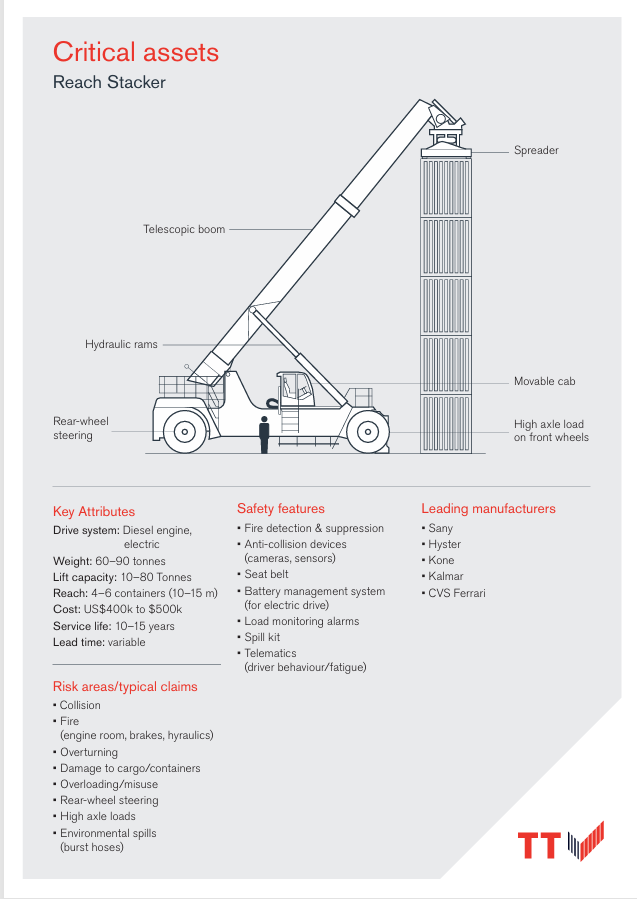
Modern reach stackers are substantial pieces of equipment, typically weighing between 60 and 90 tonnes and capable of lifting loads between 10 and 80 tonnes. Depending on configuration, they can stack containers up to four to six rows deep, providing a reach of approximately 10 to 15 metres. Units may be powered by conventional diesel engines or increasingly by electric drive systems as terminals seek to reduce emissions.
With acquisition costs commonly ranging between US$400,000 and US$500,000 and service lives of 10 to 15 years, reach stackers represent a significant capital investment for terminal operators. Long procurement lead times can also create operational challenges when replacement assets are required following a major incident.
Critical components
The most important structural and operational elements of a reach stacker include:
- Telescopic boom
- Hydraulic rams
- Spreader assembly
- Movable operator cab
- Rear-wheel steering system
- Front axle and wheel assemblies carrying significant load concentrations
These components are subject to substantial dynamic loading during operation and therefore require robust inspection, maintenance and monitoring regimes. Particular attention should be paid to hydraulic systems, boom structures and wheel assemblies, as failures can rapidly escalate into serious incidents.
Safety features
Manufacturers continue to incorporate advanced safety systems to help reduce operational risks. Typical features include fire detection and suppression systems, anti-collision technology, load monitoring alarms, seat belt systems and telematics platforms capable of monitoring equipment utilisation and operator behaviours.
Battery management systems are increasingly common on electric reach stackers, while camera-based visibility aids and proximity sensors seek to reduce collision risks in busy terminal environments. Spill kits should also be readily available to mitigate environmental impacts resulting from hydraulic hose or fuel system failures.
Risk areas and typical claims
TT Club's claims experience across the ports and terminals sector highlights several recurring loss trends involving reach stackers.
Collisions remain one of the most common causes of loss, often involving other terminal vehicles, stationary structures or containers. Restricted visibility, congested operating areas and excessive speed are common contributing factors.
Fires can originate from engine compartments, braking systems or hydraulic equipment. Poor maintenance, fluid leaks and overheating components frequently increase exposure.
Overturning incidents represent some of the most severe losses. Reach stackers routinely operate near the limits of stability when lifting heavy containers at extended boom reaches, due to the fact the centre of gravity of the vehicle moves as the boom is extended. Ground conditions, operator error, excessive speed, poor container packing and dynamic loading can all contribute to loss of stability.
Cargo and container damage often results from misalignment of spreaders, sudden movements, dropping loads or inadequate stacking practices.
Overloading and misuse place excessive stress on structural and hydraulic components, increasing the likelihood of equipment failure.
Additional risks arise from the machine's rear-wheel steering characteristics, which can create unexpected vehicle movements, and from the very high axle loads carried by the front wheels, which may contribute to pavement deterioration if not properly considered during infrastructure design and asset management.
Environmental incidents are also encountered, particularly where burst hydraulic hoses or equipment failures result in oil spills and contamination.
Key considerations for risk managers
Effective risk management should focus on:
- Operator training and competency assurance.
- Strict adherence to safe load charts and operating limits.
- Pre-use inspections and planned preventative maintenance.
- Routine inspection of booms, hydraulic systems and spreaders.
- Management of traffic interfaces and pedestrian exclusion zones.
- Monitoring operator behaviour through telematics systems.
- Verification that pavement structures are suitable for high axle loads.
- Emergency response arrangements for fires and hydraulic spills.
A structured asset management approach can significantly reduce the likelihood of catastrophic equipment failures while improving operational reliability and extending service life.
Conclusion
Reach stackers are indispensable assets for many container handling operations, offering exceptional flexibility and productivity. However, their size, lifting capability and operating environment expose operators to significant safety, operational and financial risks. By understanding the equipment's critical components, implementing robust maintenance programmes and ensuring effective operational controls, terminals can improve reliability while reducing the frequency and severity of losses.
Documents
TT Club Critical Assets - Reach Stacker (64 kB) 29/07/2026
- Date
- 22/07/2026