
TT Club critical asset series: Ship-to-Shore crane
Ship to Shore (STS) cranes
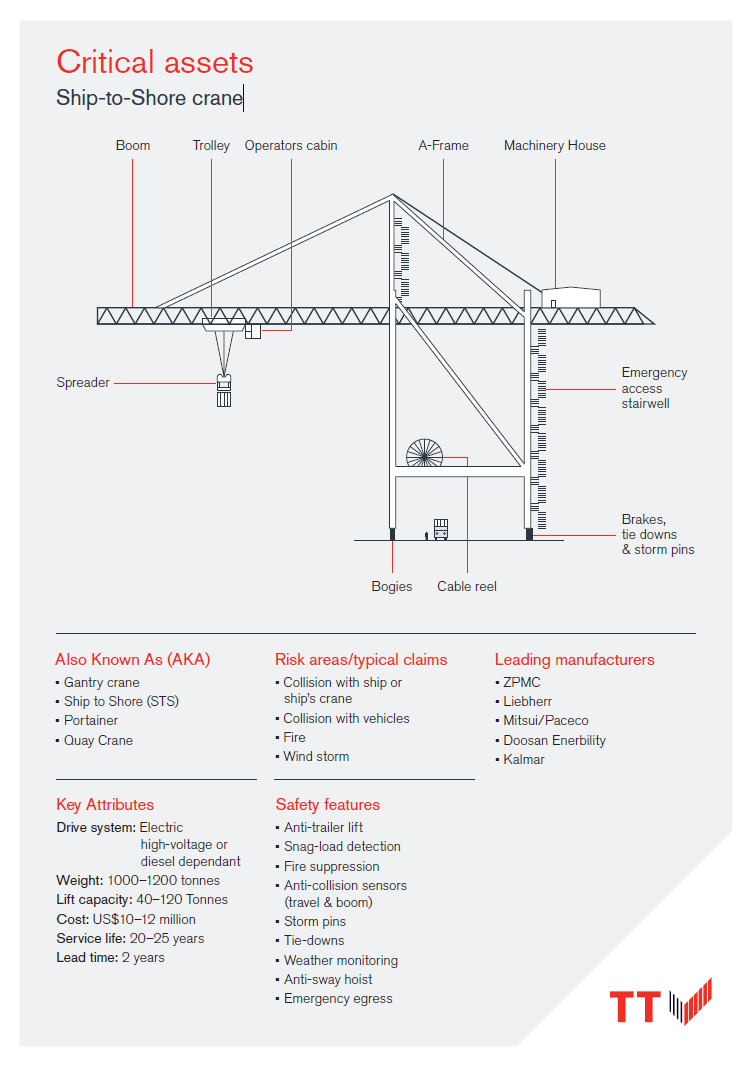
Ship to Shore (STS) cranes are among the most critical and capital intensive assets in any container terminal operation. With procurement costs reaching US $10–12 million, service lives extending 20–25 years, and lead times of up to two years, this equipment represents substantial financial commitments.
Just as importantly, they sit at the heart of cargo handling productivity. Their scale, complexity, and exposure to dynamic operational environments demand a robust approach to risk mitigation – one that prioritises operational integrity, asset protection, and, crucially, the safety of people working in and around the crane.
Understanding the asset and Its risk profile STS cranes – whether referred to as gantry cranes, portainers, or quay cranes – operate in one of the most high risk interfaces of the supply chain: the ship to shore transfer zone. Their lifting capabilities, ranging between 40–120 tonnes, combined with their sheer mass of 1,000–1,200 tonnes, create significant potential for catastrophic loss events in the event of malfunction, misoperation, or adverse conditions.
Key risk exposures include collisions with ships or vessels’ cranes, vehicle impacts beneath or around the crane structure, fire within the machinery house or electrical systems, and windstorm related incidents such as derailment or boom collapse. From a loss prevention standpoint, the claims pattern reflects a consistent trend: low frequency, high severity events that often arise from preventable scenarios. Ensuring that operational controls, maintenance disciplines, and environmental safeguards are in place is therefore central to risk management.
Engineering controls and safety features
Modern cranes incorporate a range of engineering solutions to reduce risk. Anti collision sensors – both for gantry travel and boom movement – play a vital role in preventing crane to crane, crane to ship, and crane to vehicle impacts. Anti sway hoist systems enhance lifting stability, reducing the likelihood of load swing and consequent structural or cargo handling incidents. Snag load detection protects the crane against unexpected resistance, a precursor to structural overloading and potential collapse. Fire suppression in the machinery house mitigates one of the most significant loss drivers: fires originating in electrical cabinets, hydraulic systems, or mechanical components. Similarly, weather resilience systems – including storm pins, tie downs, and wind monitoring – are essential defences against extreme gusts or cyclonic activity, which remain major contributors to crane failures worldwide. “From TT Club’s perspective, resilience is achieved through a layered approach: engineering safeguards, robust operational controls, environmental awareness, and strong safety culture.”
Emergency egress provisions, operator cabins designed for visibility and safety, and robust access systems support worker protection – aligning with TT Club’s overarching emphasis on reducing harm to people as well as assets.
Operational risk mitigation
Effective risk mitigation blends equipment capability with disciplined operational practice:
1. Collision prevention: Accidents involving vessels remain one of the most costly categories of claims. Ensuring the correct alignment of ship and crane, monitoring vessel movement, and enforcing restricted access zones beneath the crane are essential. Use of anti collision systems must be supported by thorough operator training and regular functional testing.
2. Environmental vigilance: Wind remains a major external hazard. Terminals must have clear cut off wind speeds for lifting, gantry travel, and boom positioning. Weather monitoring equipment only reduces risk when combined with enforced operational decision making.
3. Human factors: Given the reliance on operator judgement, fatigue, complacency, and communication failures routinely feature in loss investigations. TT Club advocates rigorous competency frameworks, scenario based training, and culture driven reporting of near misses.
4. Maintenance and reliability: Unplanned equipment failure can result in structural damage, fire, or load handling incidents. Predictive and preventive maintenance schedules – supported by OEM guidance from manufacturers such as ZPMC, Liebherr, Mitsui/Paceco, Doosan Enerbility, and Kalmar – are essential to sustaining crane integrity throughout its lifecycle. Conclusion The STS crane is a critical enabler of terminal productivity and a substantial financial exposure. From TT Club’s perspective, resilience is achieved through a layered approach: engineering safeguards, robust operational controls, environmental awareness, and strong safety culture. When these elements align, terminals can significantly reduce the severity and frequency of crane related incidents, protecting both people and assets while sustaining efficient operations.
Documents
TT Club Critical Asset - Ship-to-Shore crane (80 kB) 15/07/2026
- Date
- 18/06/2026