
Villari: Continuous Structural Monitoring for Safer, Smarter Infrastructure
The challenge
In the transport and logistics industry, steel infrastructure - such as cranes, bridges, and heavy lifting equipment- is the backbone of daily operations. But with constant use, environmental exposure, and heavy loading, these structures are vulnerable to fatigue cracks and stress-induced damage over time.
Traditionally, ensuring structural integrity has relied on frequent manual inspections. These inspections are not only time-consuming and costly but often require personnel to access hazardous or confined spaces. This reactive approach increases the risk of missed defects, unplanned downtime, and even catastrophic failures - posing serious safety and financial risks.
The innovation
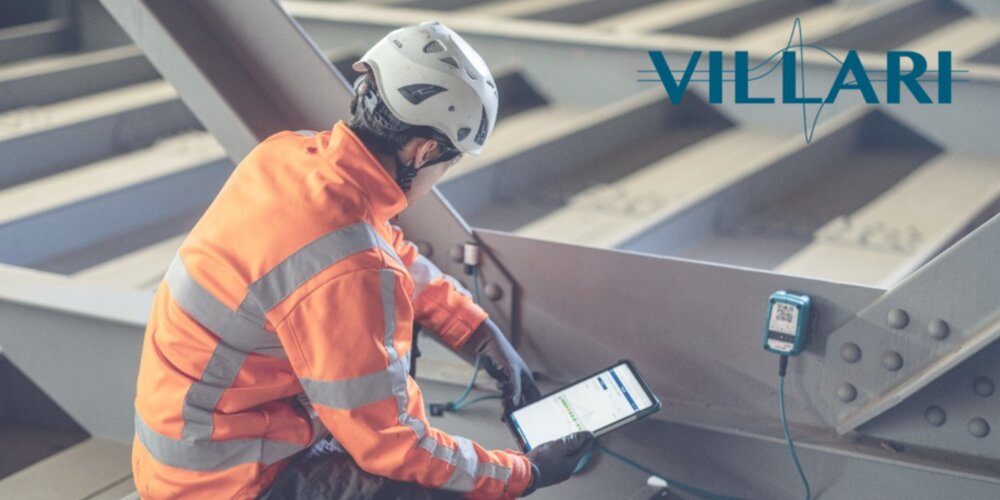
Villari has developed a groundbreaking solution that transforms how structural health is monitored. Using passive magnetic flux leakage technology, Villari’s wireless sensors continuously monitor steel structures for signs of deformation, stress, or crack growth - without the need for invasive inspections or surface preparation.
Installed at critical stress points, the sensors detect subtle changes in the steel’s magnetic field caused by structural anomalies. These changes are transmitted wirelessly via LoRa (Long Range) technology to a secure platform, where Villari’s algorithms analyse the data in real time. The result is a non-invasive, continuous inspection system that eliminates the need for frequent manual check-ups and enables proactive maintenance planning.
How it works
- Strategic sensor placement: Sensors are installed at high-risk points identified through structural analysis - either by the asset owner or in partnership with engineering experts.
- Passive magnetic monitoring: The sensors detect magnetic field variations caused by stress or crack formation, using the Earth’s magnetic field as a reference.
- Wireless data transmission: Data is sent via LoRa to a central platform for real-time monitoring and historical trend analysis.
- Remote access & alerts: Operators can access the platform from anywhere, enabling continuous oversight and timely intervention.
This system is scalable, easy to install, and requires no recalibration, which makes it ideal for complex, high-value assets in demanding environments.
Case study
Villari’s technology has been successfully deployed by major infrastructure and logistics operators, including Eurogate, Port of Antwerp, ProRail, and Hutchison Ports. These organisations rely on Villari to monitor critical assets such as cranes and bridges, ensuring safety while minimising operational disruption.
- Improved safety for both assets and personnel by reducing the need for hazardous manual inspections
- Reduced unplanned downtime through early detection of structural issues
- Extended asset lifespan by enabling data-driven maintenance and precise end-of-life assessments
- Lower operational costs through fewer inspections and more efficient repair planning
Potential impact
Villari’s wireless monitoring solution is redefining how the transport and logistics industry approaches infrastructure safety and maintenance. By shifting from reactive inspections to continuous, real-time monitoring, organisations can:
- Prevent failures before they occur
- Protect workers from hazardous inspection environments
- Optimise maintenance schedules
- Extend the life of critical assets
- Reduce costs and improve operational resilience
- Date
- 22/07/2025