
TT Talk - How is chronic climate stress affecting the resilience of inland waterway supply chains?
For decades, inland waterways have been promoted as one of the most efficient and environmentally favourable methods of transporting cargo. Barges moving freight along the Rhine, Danube, Mississippi, Yangtze and Panama waterways can move large volumes with significantly lower emissions and cost than road transport, helping businesses meet both economic and sustainability objectives.
However, a growing challenge is beginning to emerge. What happens when the water itself becomes the constraint?
Recurring drought conditions
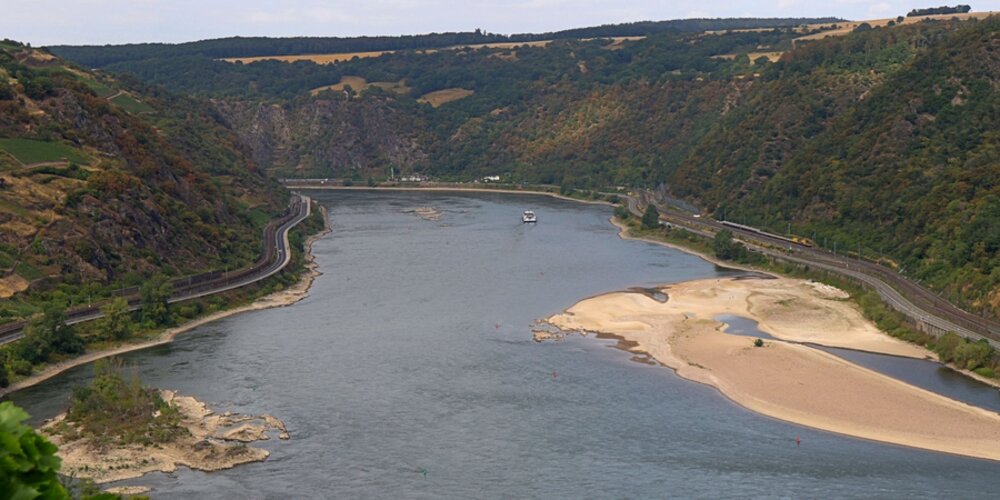
In recent years, recurrent drought conditions have reduced river levels across many of the world's major inland waterways. The consequences are becoming increasingly familiar. Vessel loading restrictions, navigation bottlenecks, reduced transit reliability, grounding incidents and rising transport costs all follow when navigable depths fall below critical thresholds. What was once considered an occasional disruption is increasingly becoming a recurring operational reality.
This shift requires a change in mindset. Drought must no longer be viewed solely as rarely occurring environmental issue. It should be considered a business continuity risk, capable of disrupting supply chains in much the same way as flooding, hurricanes, cyber-attacks or labour shortages.
For logistics providers, ports, terminals and cargo owners, the question is not whether drought will affect inland transport systems, but how prepared organisations are for increasingly frequent periods of low water operational restrictions.
Allocation of limited resources
A recent example from Europe highlights another emerging dimension of the challenge. In Romania, authorities faced difficult decisions regarding the allocation of limited water resources, balancing the needs of navigation on the Danube with those of critical infrastructure, including energy generation.
This is unlikely to be an isolated situation. As climate pressures intensify, governments may increasingly be required to prioritise water use between competing sectors such as drinking water supplies, agriculture, energy production and transportation. Few would argue against the importance of maintaining essential services for millions of people, but such decisions nevertheless demonstrate a significant reality for supply chains. Access to waterways may be affected by factors entirely outside the control of transport operators.
These examples highlight a form of climate-related risk that receives relatively little attention. While much discussion focuses on physical impacts such as flooding or storm damage, organisations must also consider the consequences of resource allocation decisions that emerge when water becomes scarce. Businesses that depend upon inland waterways may find their operations affected not only by changing environmental conditions but also by broader societal priorities.
Wider supply chain implications
The implications extend far beyond individual vessels navigating low-water conditions.
Historically, rivers have often been viewed as naturally resilient transport corridors. Yet experiences on waterways such as the Danube and Rhine increasingly suggest they should be regarded as climate-vulnerable infrastructure assets.
Reduced draughts limit carrying capacity and increase operating costs. Bottlenecks can create delays throughout interconnected transport networks. Ports may experience fluctuating throughput volumes. Warehousing operations may encounter inventory imbalances. Rail and road providers can face sudden surges in demand when cargo is diverted away from waterways.
The result is a cascade of disruptions that extends well beyond the river itself.
Remodelling supply chains?
This represents a particular challenge because many transportation strategies have increasingly encouraged a modal shift towards inland waterways as part of wider decarbonisation efforts. The environmental advantages remain compelling. However, sustainable transport choices must also be resilient transport choices.
The objective should not be to move away from inland waterway transport, but to ensure organisations fully understand and manage the associated risks. Climate resilience must be incorporated alongside carbon reduction objectives within supply chain planning.
A chronic challenge
Perhaps the most important lesson from recent drought events is that they are no longer exceptional.
Many resilience strategies continue to focus on sudden shocks. Hurricanes, floods, earthquakes and major accidents tend to capture attention because they occur rapidly and create visible disruption. Yet slow-building climate pressures may ultimately prove more challenging to manage.
Extended droughts, prolonged heatwaves, changing precipitation patterns and declining water availability develop gradually. Organisations often have more time to observe these changes, but they may struggle to respond because traditional planning assumptions remain unchanged.
The challenge is not a single dramatic failure. It is the gradual degradation of operating conditions over months or even years.
This requires a different approach to resilience planning. Rather than preparing solely for extreme events, companies should consider how their operations would perform under persistently constrained conditions. What happens if river levels remain below historical averages for consecutive seasons? What if carrying capacities are repeatedly reduced? How quickly can alternative transport arrangements be activated?
The cruise industry's response to low-water events provides an interesting analogy. Operators have increasingly adapted through vessel swaps, itinerary amendments and alternative transport arrangements. Freight supply chains may need to demonstrate similar levels of agility.
The most resilient organisations will be those that understand their dependencies, identify alternative transport options and establish contingency plans before disruption occurs.
Perhaps the most important lesson from recent drought events is that they are no longer exceptional.
Climate informed decision making
Ultimately, the industry may need to move away from planning based primarily on historical norms and towards a model built around climate-informed decision-making.
Real-time river level monitoring, drought forecasting, remote sensing technologies, predictive analytics and advanced modelling tools are increasingly available. Combined with operational experience, these capabilities can support more informed decisions regarding cargo planning, route selection, fleet deployment and contingency arrangements.
Climate intelligence is rapidly becoming integral to supply chain capability rather than a purely environmental function.
Summary
Inland waterways will continue to play a critical role in global logistics and decarbonisation strategies. However, recent drought conditions serve as a reminder that resilience cannot be assumed.
As climate patterns continue to evolve, the most successful organisations will not simply be those that choose the lowest-emission transport option. They will be those that combine sustainability objectives with a clear understanding of climate-related operational risk, building the agility and resilience required to navigate a future in which water itself may become one of the supply chain's most critical constraints.
Documents
TT Talk - Edition 338 - Chinese (647 kB) 07/10/2026
- Author
- Neil Dalus
- Date
- 08/09/2026

09/10/2026
Ozan Durak named YLP Global Winner at 2026 FIATA World Congress
FIATA, the International Federation of Freight Forwarders Associations, in partnership with TT Club, is pleased to announce the 2026 Global Winner of the FIATA Young Logistics Professionals (YLP) Award, presented during the 2026 FIATA World Congress in Milan, Italy, during the 100th years of FIATA.