
Case Study: Building a Climate‑Ready Supply Chain with Haskoning
Overview
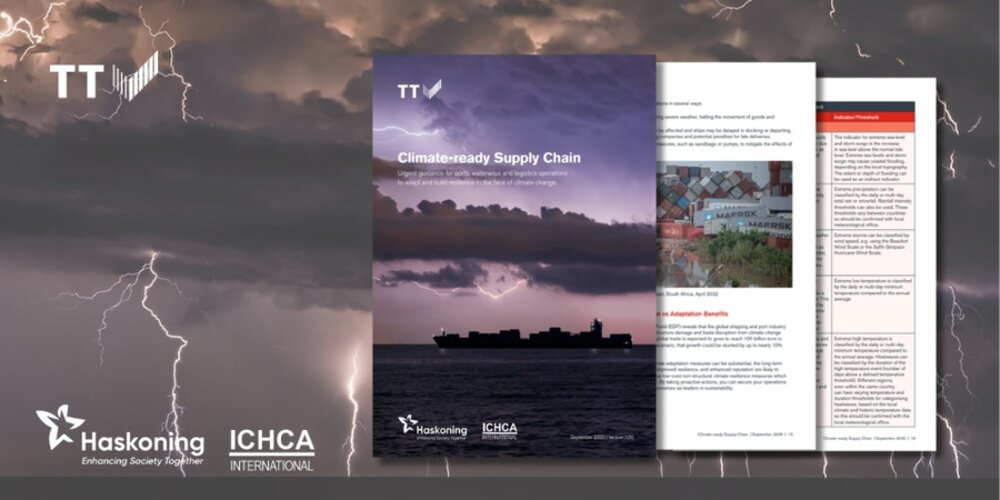
As climate change accelerates, ports, waterways, and logistics operators face rising levels of physical and transitional risk. Extreme weather events, sea‑level rise, heatwaves, coastal erosion, and precipitation volatility increasingly threaten the resilience of global supply chains. Recognising these growing challenges, Haskoning UK Ltd. (Royal HaskoningDHV) — a global engineering, design and consultancy firm — partnered with TT Club and ICHCA International to produce the Climate‑ready Supply Chain guidance (September 2025).
This case study demonstrates how Haskoning’s climate-risk and adaptation expertise underpins the development of robust, actionable frameworks designed to help operators build climate resilience and safeguard long‑term operational continuity.
The Challenge
Global ports face unprecedented exposure to climate‑driven hazards:
- Nearly 90% of major ports face damaging climate hazards such as cyclones, sea‑level rise, storm surge, and extreme heat.
- Disruptions from extreme weather already place $67 billion of global trade at risk annually.
- Major historical events — such as Hurricane Katrina and the 2011 Tōhoku tsunami — highlight the vulnerability of even advanced infrastructure.
- Extreme heat, drought, flooding, and coastal erosion increasingly undermine workforce safety, operational capacity and financial stability.
Operators urgently need a structured, scientifically grounded approach to climate adaptation that supports decision‑making, investment planning, and prioritisation.
Haskoning’s Role
Haskoning brought its deep expertise in climate science, engineering design, and resilience planning to lead the development of the whitepaper’s technical framework. The company’s contributions included:
1. Translating Climate Science into Actionable Guidance
Haskoning synthesised multiple streams of climate projections, modelling techniques, and scenario frameworks (including IPCC AR6, RCPs, and SSPs).
This was used to create a clear, practical methodology for:
- Interpreting climate data
- Assessing baseline and future risks
- Understanding chronic and acute hazards
- Applying scenarios to long‑term planning
Their work bridges the gap between complex climate modelling and real‑world operational decision‑making.
2. Creating a 5‑Stage Climate Resilience Journey
Haskoning developed the structured lifecycle used throughout the guidance:
- Understanding climate change
- Hazard and risk insights
- Climate adaptation planning
- Resilience solutions
- Staying climate resilient
This simple, visual pathway equips organisations to progress from early awareness through to full implementation and ongoing monitoring.
3. Providing Worked Examples and Practical Measures
Haskoning designed step‑by‑step examples demonstrating:
- How to identify hazards such as heatwaves or extreme precipitation
- How to assess exposure and vulnerability
- How to translate risk assessment into operational, engineered, or behavioural interventions
- How to evaluate adaptation options (including cost‑benefit analysis)
These examples make the guidance universally usable — from small port authorities to major multinational operators.
4. Guiding Climate‑Resilient Engineering Solutions
Drawing on decades of port, coastal, and infrastructure design experience, Haskoning contributed technical insight on:
- Flood defences and elevated quay walls
- Storm‑resistant structures
- Drainage upgrades
- Nature‑based coastal protection
- Renewable energy integration
- Temperature‑resilient design and materials
These solutions allow operators to plan targeted, cost‑effective resilience upgrades.
5. Embedding Climate Risk into Business Strategy
Haskoning supported the development of frameworks for integrating:
- Physical risk
- Transition risk
- Regulatory compliance
- Operational adaptation
- Long‑term investment planning
This aligns operational strategy with future climate realities and ensures resilience is embedded across whole organisations.
Outcomes & Impact:
A Clear, Practical Roadmap for the Global Ports Sector
Thanks to Haskoning’s technical leadership, the resulting whitepaper is one of the most comprehensive climate‑resilience guides available to the transport and logistics industry.
Key achievements include:
- A complete, implementable methodology
- Clear, repeatable steps enable organisations to determine climate‑related vulnerabilities and prioritise adaptation strategies.
- Practical, real‑world actions
- From no‑regret measures to long‑term engineered solutions, the guidance equips operators to take immediate and phased action.
- Integration with international standards
The whitepaper outlines how adaptation can align with frameworks including:
TCFD, ISSB, CSRD, GRI, SASB and PIANC guidelines, enabling operators to report and act consistently.
✔ Strengthened global resilience thinking
Case studies from Rotterdam, Vancouver, Long Beach, Brisbane and Greater China demonstrate how climate adaptation can deliver:
- Reduced downtime
- Lower long‑term cost exposure
- Higher operational continuity
- Improved reputation and investment appeal
✔ Tools to future‑proof infrastructure
With Haskoning’s engineering and environmental expertise, operators can confidently plan for:
- Sea‑level rise
- Extreme storms
- Heatwaves
- Precipitation volatility
- Coastal erosion
- Changing navigational conditions
Conclusion
Haskoning’s climate adaptation and engineering expertise was central to creating a globally relevant, scientifically grounded, and operationally practical framework for building climate‑ready supply chains.
By combining rigorous climate science, risk assessment methodologies, and engineering practicality, Haskoning has helped empower the global ports and logistics sector to:
- Understand climate risk
- Act decisively
- Build resilience
- Protect infrastructure and people
- Ensure long‑term operational continuity
This case study demonstrates Haskoning’s leadership in delivering sustainable, future‑proofed solutions for some of the world’s most critical infrastructure.
Documents
TT Club - Climate Ready Supply Chain Whitepaper (6.12 MB) 22/09/2025
- Author
- Neil Dalus
- Date
- 03/02/2026

22/09/2025
Climate-ready Supply Chain: Urgent Guidance for Ports, Waterways and Logistics Operations

25/02/2026
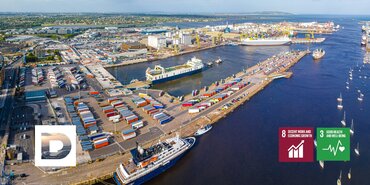
Raising safety standards across the port estate
A key role of port authorities is to drive safety across their ports for the benefit of both port users and workers. Dublin Port’s SafePort initiative is a great example of programme which has transformed safety culture across Ireland’s busiest ports.