
Vehicle Carrier Safety Forum publishes guidance on fire response
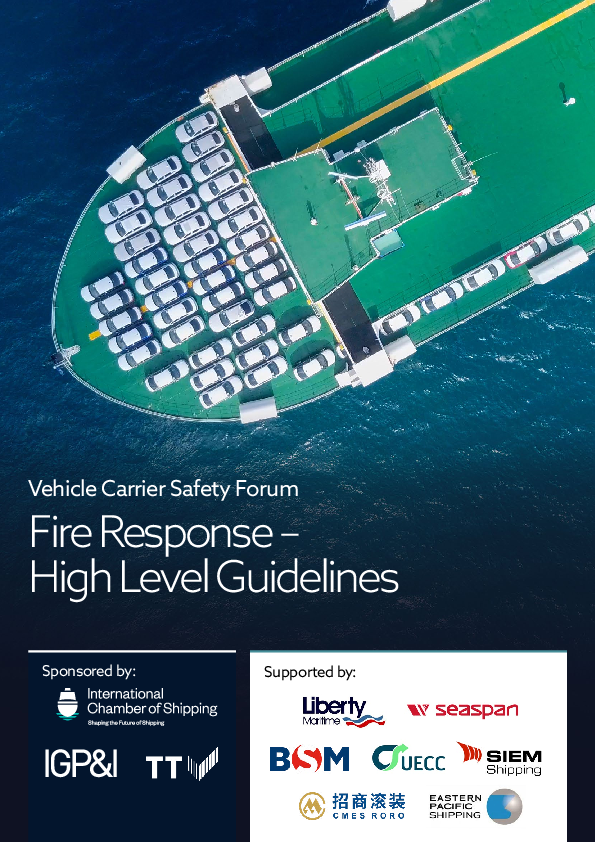
The Vehicle Carrier Safety Forum (VCSF) has prepared high-level guidelines to improve safety during vehicle fire incidents on board Pure Car Carriers (PCCs), Pure Car and Truck Carriers (PCTCs), RoRo, and Ro-Pax vessels. Addressing the unique challenges of responding to vehicle fires, these guidelines do not offer exhaustive procedures due to the variability in ship designs and equipment, but instead provide a framework for operators to tailor their response strategies.
These guidelines cover both Internal Combustion Engine (ICE) vehicles and electric vehicles (EVs), with particular attention to the risks posed by lithium-ion batteries. Fires involving EVs can escalate quickly, often becoming more complex and challenging to extinguish compared to conventional ICE fires. Therefore, the guidelines emphasise early suppression using Fixed Firefighting Systems (FFS) and the importance of rapid intervention within minutes of detection. Timeliness is crucial, with a recommendation that fire control measures be implemented within 10-15 minutes of the first alarm.
A robust response plan that accounts for the different scenarios at sea and in port is essential. Drill scenarios should include realistic early strategies for using FFS to improve crew preparedness. Additionally, operators must stay vigilant about fire risks during both stowage and while the vessel is manoeuvring, adjusting their fire response plans accordingly.
Beyond immediate fire control, procedures must also be in place for monitoring the controlled fire situation to prevent re-ignition. The potential hazards of explosive vapour clouds produced by EVs during thermal runaway necessitate expert evaluation and carefully crafted response plans. Personal protective equipment standards should be upheld to safeguard crew members from toxic exposures.
These guidelines serve as an essential tool for enhancing safety and preparedness against increasingly prevalent vehicle fire scenarios at sea.
Key takeaways
- Guidelines support vessel operators in fire preparedness.
- Emphasis on rapid response within 10-15 minutes.
- Recommendations for using Fixed Firefighting Systems swiftly.
- Stowage and fire response plans must be adaptable.
- Expert assessments are crucial for managing complex fire situations.
Frequently asked questions
What are the main fire risks on vehicle carriers?
Risks include fires from Internal Combustion Engine (ICE) vehicles and lithium-ion batteries in electric vehicles.
How quickly should fire response be initiated?
Fire control measures should be initiated within 10-15 minutes of an alarm to be effective.
What is the role of Fixed Firefighting Systems?
FFS is recommended for early fire suppression to manage developing fires quickly and effectively.
Documents
VCSF-_Fire_Response_-_High_Level_Guidelines.pdf (459 kB) 10/08/2026
- Date
- 12/06/2025